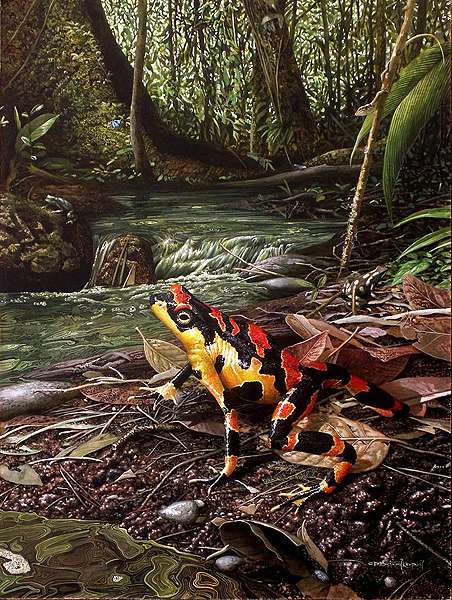
acrylic on illustration board 20” x 15” $7,200. During the dry
season, over 100 populations of Varied Harlequin Toads (Atelopus
varius) once congregated along forest streams in Costa Rica
and western Panama to breed. Cloaked in a wide variety of colors
and patterns, these beautiful amphibians ranged from cream to
lemon yellow, to lime and scarlet, or various combinations of
these base hues, splotched or barred with brown, green or black.
Ranging in length from one to two inches, the males averaged
about a quarter smaller than females. Their gaudiness was probably
a case of aposematic, or warning coloring, as their skin
contained quantities of the toxic alkaloid tetrodotoxin. In the
late 1980s most populations began a steep decline, beginning
in central Costa Rica. The Panamanian frogs didn't start to crash
until about 1992. The causes of this crash are still poorly understood,
and the subject of some controversy, but the insidious chytrid
fungus Batrachochytrium dendrobatidis plays an important
role. How, and even whether Bd, as the fungus is commonly
known, kills frogs still is a mystery, but circumstantial evidence
is accumulating that points to it as the direct cause of much
global frog decline. The Varied Harlequin Toad and other members
of the genus Atelopus appear to be quite susceptible to Bd,
and of the 120 or so species, some 60% are believed to have recently
gone extinct in the wild. Wild populations of A. varius
were feared extinct, but a small population near Quepos, Costa
Rica, discovered in 2003, perseveres. Incidental species include
a leaf-cutter ant (Atta sp.), the butterfly Morpho
amathonte, a Cloud-forest Anole (Anolis tropidolepis)
and a Blue-gray Tanager (Thraupis episcopus). |